This article is for informational purposes only. Ascend does not provide legal advice, and is not an attorney.
What Are the Chapter 7 Income Limits in California in 2026?
Quick answer:
For cases filed on or after April 1, 2026, the California Chapter 7 income limit starts at $79,253 for a household of 1 and increases based on household size.
If your household income is below the California median, you may usually pass the first part of the Chapter 7 means test.
If your income is above the limit, you may still qualify after applying allowed expenses and deductions.
California Chapter 7 Means Test Calculator
There are three US bankruptcy forms used to estimate qualification. The calculator below is based on the Chapter 7 Statement of Your Monthly Income form and helps estimate both:
Real Example Results From California's Income Limit Calculator
After completing the calculator, you’ll see a breakdown like the examples below based on your income, debt, and household size.
What the calculator considers:
- Household size
- Income (before taxes, all sources)
- Debt amount
- Expenses (housing, car, etc.)
- Assets (home equity, vehicles, savings)
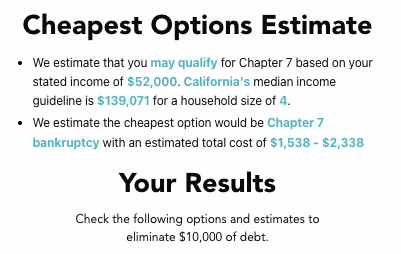
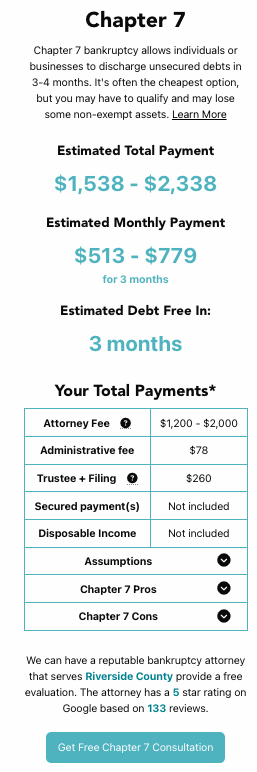
→ Example 1: May Qualify For Chapter 7
Family of 4 earning ~$52K/year with ~$10K in debt
The results will provide you with a breakdown estimate on qualification, along with alternatives to Chapter 7 to compare side-by-side
- Cheapest option: Chapter 7
- Total cost: $1.5k -$2.3k
- Timeline: ~3 months
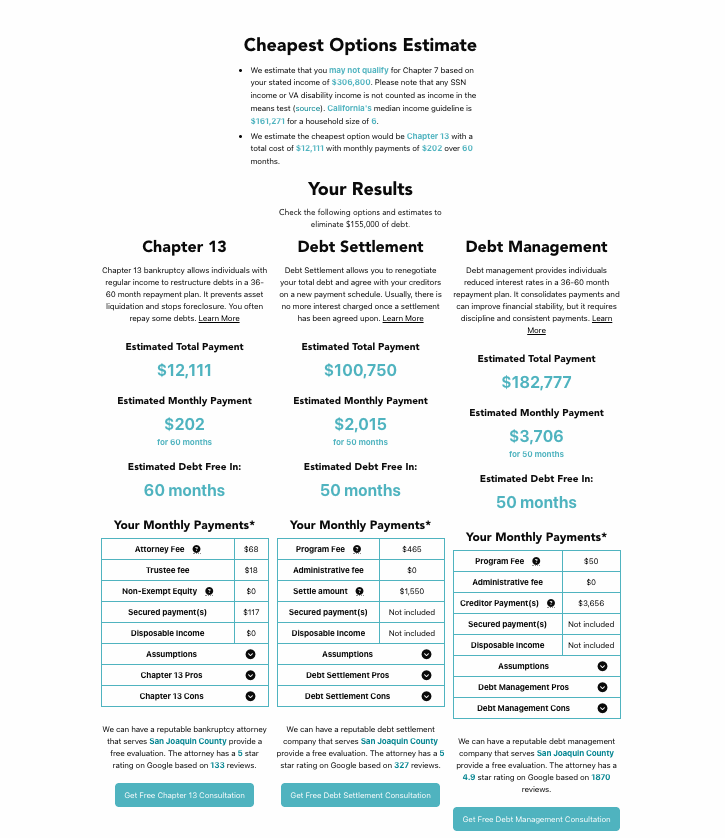
→ Example 2: May Not Qualify For Chapter 7
Family of 4 earning ~$306k/year with ~$155k in debt
What happens after you use the income limit calculator?
You’ll see a side-by-side comparison of your estimated payments across common debt relief options, including:
- Chapter 13 bankruptcy repayment plan – Protect assets while repaying debt over time
- Debt settlement programs – Settle debts for less than what you owe
- Debt management plans (DMPs) – Lower interest rates and simplify payments
This helps you understand which option may cost the least and fit your situation best.
California Chapter 7 Bankruptcy Income Limit
The California bankruptcy income limits are based on median household income and updated periodically.
Below is the income limits for cases filed on or after April 1, 2026. If your income is below your household size threshold, you may often pass the first step of the means test.
| # of People | Annual Income |
|---|
| 1 | $79,253 |
| 2 | $102,797 |
| 3 | $116,541 |
| 4 | $139,071 |
| 5 | $150,171 |
| 6 | $161,271 |
| 7 | $172,371 |
| 8 | $183,471 |
| 9 | $194,571 |
How Does the California Chapter 7 Means Test Work?
According to the United States Trustees' office, the means test is a standardized bankruptcy form that you complete to file for bankruptcy.
You can think of it as an income test.
The bankruptcy forms calculate your average monthly income. It then annualizes that figure to calculate your average annual income.
Here are some important things to note about the bankruptcy means test:
- The means test applies to your entire household income, even if your spouse is not filing with you. This may be different if you are legally separated.
- The household income is used for the bankruptcy means test in California. As such, it compares your average household income to other household incomes in California. The figures used for the means test come from the Census Bureau data.
- Here’s the specific language used for the average monthly income used for the California bankruptcy means test.
- Fill in the average monthly income that you received from all sources, derived during the 6 full months before you file this bankruptcy case. 11 U.S.C. § 101(10A). For example, if you are filing on September 15, the 6-month period would be March 1 through August 31. If the amount of your monthly income varied during the 6 months, add the income for all 6 months and divide the total by 6. Fill in the result. Do not include any income amount more than once. For example, if both spouses own the same rental property, put the income from that property in one column only. If you have nothing to report for any line, write $0 in the space.
- If your income is variable, you may consider using this average income calculator. This calculator was built to estimate your average monthly income for the California means test.
Let's now cover the bankruptcy means test calculation in California for bankruptcy cases filed this year
What Income Counts for the California Means Test?
Not all income is included in the bankruptcy means test. For example, some disability and social security income are
not included in the bankruptcy means test. Other incomes that are not included in the California means test are payments of victims of war crimes and payments related to a national emergency (such as COVID-19).
So, let's go through the types of income included in the California bankruptcy means test. The language includes any amount paid by any entity other than the debtor, on a regular basis, for household expenses of the debtor. It's a broad definition, so let's cover a few of the types of income included
- Salaried income
- Spousal income (in a joint case or if not legally separated)
- Hourly and overtime income
- 1099 Income (Uber, Lyft)
- Net Rental Income
- California government income
- Child Support and Alimony
- Dividend, Interest, and Royalties
- Pension and Retirement Income
- Net business income
- Annuity payments
- Unemployment compensation
- Worker's Compensation Benefits
What Is Considered In Household Size?
Another common question is
how household size is determined. While your roommate may not be included in your household size, your children you report as dependents on your taxes often are.
If you have children away for college or are engaged, but not yet married, there may be rules in different California bankruptcy jurisdictions on who can be counted.
What If Your Income Is Above The Limit?
Now it's time to understand part 2 of the means test and whether you can potentially qualify even if you are above the Chapter 7 California income limit.
You may have taken the calculator above, and your income is above the household income level for California. If so, you may still qualify based on the next two means test forms: 1. Statement of Exemption from Presumption of Abuse Under §707(b)(2) and 2. Chapter 7 Means Test Calculation. The second portion of the means test allows you to deduct allowable monthly expenses from your current monthly income (CMI) to calculate your disposable income. The expenses used are a combination of national and California expenses.
As a note, disposable income is the income available after expenses that may be used to repay your debts. If your disposable income is below a specific amount, you may still qualify for a Chapter 7 bankruptcy.
The California above-median bankruptcy means test calculator uses both forms to help you determine allowable expenses to estimate Chapter 7 qualification.
Allowable deductible expenses
Here are certain expenses that you may deduct from actual expenses on the second part of the bankruptcy means test.
- Mandatory employment deductions, such as union dues, retirement plans, and uniforms
- Health and disability insurance premiums
- Income taxes
- Child Care expense
- Term life insurance premiums
- Secured debt payments for your car and home
- Alimony and child support payments
- Charitable contributions (limited to a percentage of your income)
You may also deduct other expenses for special circumstances. The expenses below are limited and based on the number of individuals in your household. You can refer to the current national standards for the maximum amounts allowed for the following expenses.
- Housekeeping supplies
- Clothing
- Food
- Personal care services and products
- Housing and utility expenses
- Transportation expenses
- Out-of-pocket healthcare expenses
What happens if you fail the bankruptcy means test? Let's cover that next.
What Happens If You Do Not Pass the Means Test?
If you fail the bankruptcy means test, you still have options.
For example, you can consider a Chapter 13 bankruptcy in California. You may also consider bankruptcy alternatives such as debt settlement, debt management or debt payoff planning.
Is Chapter 13 Better If You Do Not Qualify for Chapter 7?
A Chapter 13 bankruptcy in California is known as a wage earner’s plan. In many cases, you will pay back a portion of your unsecured debts in a payment plan. You are often able to keep your assets, and there’s no qualification as long as you are under the debt limits. It’s also on your credit report for 7 years, instead of 10. It can take 36 or 60 months. If you are in a 100% Chapter 13, your payment plan may be shorter.
What Other Debt Relief Options Are Available in California?
If bankruptcy is not the right fit, there are alternatives.
Debt Settlement
Debt settlement is also known as debt relief when a company or you negotiate to lower your debt balance to less than what you originally owe. That way, a portion of what you were supposed to pay back will be forgiven. For example, if you owe in debt $50,000, debt settlement is able to negotiate the amount down to $25,000. The debt settlement program is often a payment plan lasting 12 to 60 months.
Debt settlement can be less expensive than Chapter 13 bankruptcy, but be cautious about which debt settlement company you choose. Some debt settlement companies charge in excess of 25% of your enrolled debt, which is very expensive over the life of the program. You can check the Consumer Finance Protection Bureau's up-to-date information on debt settlement programs, or you can reach out to us for more information.
Many debt settlement firms are also national firms, so you do not necessarily need to find one local in California.
Debt Management
Debt management (also known as credit counseling) is when a company negotiates to lower the interest rate of your debt. For example, if you owe a blended interest rate of 22%, a debt management company may be able to negotiate it down to 9%. Many debt management companies are non-profits and will work with credit cards, but may not work with unsecured personal loans. The debt management program is often a payment plan that could be between 36 and 60 months. Many debt management firms are also national firms, so you do not necessarily need to find one local in California.
How to Know If You Should Use the California Means Test Calculator?
You should use the calculator if:
- You are considering Chapter 7 bankruptcy in California
- You are unsure if your income is too high
- Your income varies month to month
- You want to compare all available options
If your income is below the median, the process is usually straightforward. If it is above, the calculator helps estimate deductions and next steps.
Key Takeaways: California Chapter 7 Income Limits in 2026
The California Chapter 7 income limit determines whether you pass the first part of the bankruptcy means test.
Here are the most important points:
- Income limits in California start at $79,253 for a household of 1
- If your income is below the median, you will usually qualify
- If your income is above the limit, you may still qualify after deductions depending on your situation
- The means test uses income from the past 6 months
- Household size directly affects your qualification
- If Chapter 7 does not work, other options are available
Many people wait too long to explore their options. Based on Ascend’s experience, understanding your qualification early can significantly expand your choices.
Hopefully, this article has been helpful. If you want to estimate your Chapter 7 qualification, feel free to use the California bankruptcy means test calculator below.



 Yes
Yes No
No