Advertiser's Disclosure

How the Site Works: Ascend's mission is to take the pain out of personal finance for everyone. Not everyone who comes to our site is currently best fit for the Ascend product, so we spend a great deal of time and effort finding partners that we hope will be beneficial to you.

How We Make Money: Our partners sometimes compensate us in the way of advertising. Some partners we recommend pay us referral fees for sending them new customers. If you click through an application link on our site and end up receiving the service, we may receive compensation when your application is approved, and you move forward with this product. Each partner is vetted based on the following criteria:

  1. We prioritize lower interest rate providers.
  2. We prioritize those who do not penalize checking your rate or have prepayment penalties.
  3. We prioritize those that are customer experience focused. We measure this by the reviews on more unbiased review sites.

Chapter 7 Means Test Calculator: Estimate Qualification and Cost

Writer: Ben Tejes
January 9th, 2023
Attorney: Gregory J. Wald
Writer: Ben Tejes
January 9th, 2023
Do you qualify for Chapter 7?

Most people qualify if they haven't filed a previous bankruptcy too recently, and their income is below their state’s median, or if they pass a second step based on their expenses.

This calculator helps you:

  • Estimate if your income qualifies for Chapter 7

  • See your projected costs

  • Compare Chapter 7 vs other options

How Does the Chapter 7 Means Test Work?

The Chapter 7 Means Test Calculator below highlights whether you appear to qualify for a Chapter 7 bankruptcy in your state for cases filed in 2026. Because the calculator is an estimate, your actual results may vary.

Real Chapter 7 Means Test Calculator Examples: Do You Qualify?

The Chapter 7 Means Test Calculator follows the protocol used by official US Bankruptcy Forms. We use the Chapter 7 Statement of Your Current Monthly Income (Form Number: B 122A-1) for our Chapter 7 means test calculator and the Chapter 7 Means Test Calculation (Form Number: B 122A-2) for our above-median Chapter 7 calculator. The above-median calculator uses the second part of the means test.

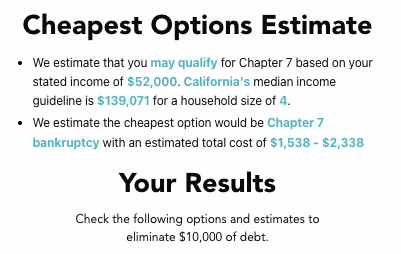
What do the results of the calculator look like? See an example below that shows the Chapter 7 calculator results, including the income threshold in your state, how much your annualized income is estimated, and whether you may qualify for Chapter 7 bankruptcy. It also uses our database to determine an estimated all-in price based on where you live.

What the calculator considers:

  • Household size
  • Income (before taxes, all sources)
  • Debt amount
  • Expenses (housing, car, etc.)
  • Assets (home equity, vehicles, savings)
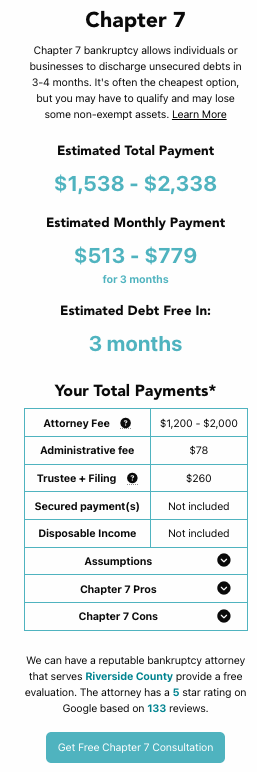
→ Example 1: May Qualify For Chapter 7
Family of 4 in California earning ~$52K/year with ~$10K in debt
The results will provide you with a breakdown estimate on qualification, along with alternatives to Chapter 7 to compare side-by-side
  • Cheapest option: Chapter 7
  • Total cost: $1.5k -$2.3k
  • Timeline: ~3 months
Most filers in this range keep their car, savings, and personal belongings, depending on their state's exemption limits.

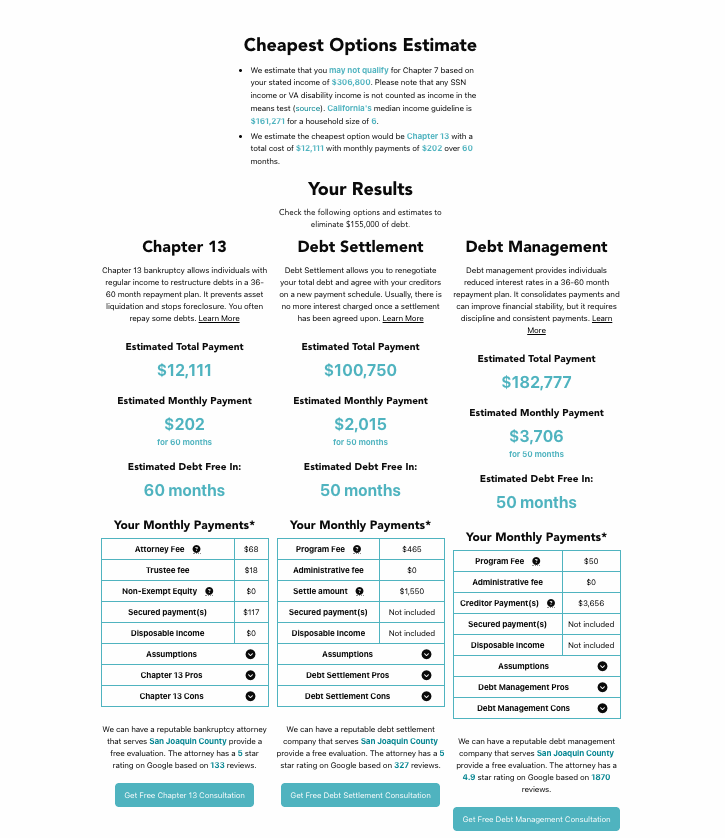
→ Example 2: May Not Qualify For Chapter 7
Family of 4 in California earning ~$306k/year with ~$155k in debt

What happens after you use the bankruptcy calculator?
 You’ll see a side-by-side comparison of your estimated payments across common debt relief options, including:
  • Chapter 13 bankruptcy repayment plan – Protect assets while repaying debt over time
  • Debt settlement programs – Settle debts for less than what you owe
  • Debt management plans (DMPs) – Lower interest rates and simplify payments
This helps you understand which option may cost the least and fit your situation best.

How The Chapter 7 Means Test Works

The means test comes down to one simple question:

Do you have enough income left over to repay debt?

Here’s how it’s calculated:

Step 1: Compare Your Income to Your State Median

The first step looks at your gross income (before taxes).

If your income is below your state’s median, you may likely qualify right away.

→ We use official data from the U.S. Bankruptcy Forms and your state’s median income to make this comparison.

Step 2: Apply IRS Allowed Expenses

If your income is above the median, the test doesn’t stop there.

You can subtract certain IRS-allowed expenses to reduce your income.

→ These standardized expense limits are set by the IRS allowable expenses and are used in bankruptcy calculations. For some expenses, you can exceed the allowed expenses if you can show that you have no other alternative for lowering your expenses.

Step 3: Use Your Actual Expenses (If Needed)

In some cases, you can go further and use your real expenses — like:

  • Mortgage or rent

  • Car payments

  • Health insurance

  • Taxes (This is the amount that you must pay to break even at the end of the year)

This is where many people still qualify, even if they initially look a tad over the limit.

→ Bottom line: Even if your income looks too high, you may still qualify once expenses are factored in. 

Related Reading: Are Disability Benefits and Social Security Income Exempt from the Bankruptcy Means Test?

What is the Bankruptcy Means Test Calculator?

The means test is what determines whether you qualify for Chapter 7.

It answers one question:
Do you have enough income to repay your debt or not?

A Chapter 7 is a form of liquidation bankruptcy, meaning that certain property that is not protected in bankruptcy can be liquidated by the Bankruptcy Court to pay a dividend to your creditors. (There are exemption laws that specify types and amounts of property that you can keep.) In return, certain debts can be wiped out if you qualify.

To figure that out, the test looks at:
Ascend's chapter 7 means test calculator uses the most recent Census Bureau Median Family Income as of November 1st, 2025, provided by the United States Department of Justice. The calculator is able to automatically pull the median income based on the zip code you provide and compare it to the income that you provide.  

Of course, there are certain exemptions where you may still qualify for a Chapter 7 even though your income is above the median. However, these are on a case-by-case basis that we will address.

Related Reading: What Income Is Included in The Bankruptcy Means Test?


Bankruptcy Means Test Part 1: Using IRS Accepted Figures

The bankruptcy means test may consider where you live in addition to both local and national standards when deciding disposable income. What this means is that you may not be able to use your real expenses that are higher than the allowed expenses to help reduce your disposable income.

Bankruptcy Means Test Part 2: Using Actual Expenses

There are some instances where you are able to use expenses such as car payments, childcare, mortgages, health insurance, and taxes to pass the Chapter 7 means test by deducting the actual expenses.

For example, let's say that you are a higher-earning debtor with income above the median based on your household size in your state. You may be able to pass the means test if you are able to reduce some of your actual expenses from your earnings for the means test. A qualified bankruptcy attorney should be able to walk you through this piece.

For expenses like car payments, childcare, mortgages, health insurance, taxes to mention but a few, you can pass the means test by deducting the actual expenses. For instance, let’s say that you are a high-earnings debtor. Do you know that you can still pass the means test if you also have a massive mortgage expense? This is because you can deduct the full mortgage amount from your earnings on the means test.

If you took the calculator above and it shows that you may not qualify, try taking the Chapter 7 Above Median Calculator to see whether you may still qualify for Chapter 7. The Above Median Calculator uses part 2 of the means test, specifically these bankruptcy forms: Statement of Exemption from Presumption of Abuse Under §707(b)(2) and the Chapter 7 Means Test Calculation.

Below is a picture of the actual means test form that our Chapter 7 means test calculator follows:


Chapter 7 Means Test Calculation - Picture of Official Form


Now that you have an understanding of the bankruptcy means test, let's dig into how the Chapter 7 means test works.

What is the Chapter 7 Means Test Process?

The Chapter 7 means test considers various factors about you to decide whether or not you qualify for a Chapter 7 Bankruptcy. Some of these aspects include your expenses, income, and the size of your household.

The Chapter 7 means test is meant to help determine if the individual has disposable income to pay back debts and ultimately disqualify people who have high earnings from filing for a Chapter 7 Bankruptcy. "Disposable income" is the amount that is left over after deducting living expenses from net income that could be used to pay creditors. This is well explained in the Bankruptcy Abuse Prevention and Consumer Protection Act of 2005 (BAPCPA). In a nutshell, it calculates whether you can pay back part of what you owe.


Chapter 7 Means Test Process

The means test has two main parts, both focused on calculating your income and determining whether anything is left over after basic expenses.

As stated above, the Chapter 7 means test has two sections, all designed to determine whether you have any disposable earnings that can be used to offset your debt.

How your income is calculated:

The process starts by looking at your average monthly income over the 6 months before filing.
→ This follows the official bankruptcy form (Official Form 122A-1), which requires you to total all income received that was earned during that period and divide it by six.

For example, if your income changes month to month, all six months are combined to get an average. Each source of income is only counted once. If you received the income during the six months, but it was earned earlier, then it is not included in the means test. For instance, one person received a bonus recently from her employer, but it was earned over the past 12 months. That means that she only needed to include half the bonus in her income calculation.

How the test uses that number
Once your average income is calculated, it's compared to your state's median income for your household size. 
→ You can find those figures in the Census Bureau Median Family Income by Family Size, which is updated regularly.

  • If you're below the median, the process is usually straightforward
  • If you're above, additional calculations may be required

Passing Chapter 7 Means Test (Income < State Median)

Let’s say that your current earnings every month are not more than your state’s median income for the size of the household that you have. Or in simpler terms, your monthly income is less than the average income in your state. This generally means that you have passed the means test in the first stage and that you do not have to do the other parts of the test. It also implies that you may be able to file a Chapter 7 Bankruptcy.

It is vital to note that merely acing the test doesn’t mean that you automatically qualify for Chapter 7 bankruptcy. There may be additional forms that are needed for the court. These forms are the Schedule I: Your Income and Schedule J: Your Expenses. In the case where you have a large amount remaining after your disposable income after your monthly expenditures, the court may be interested to dig into that information further.

Finally, keep in mind that just because you are eligible for a Chapter 7 does not automatically mean that you must file for bankruptcy. As such, you may want to consider all of the pros and cons of filing bankruptcy beforehand.

Passing Chapter 7 Means Test (Income > State Median)

What happens to debtors if you are above-median income for your state? You may want to check out our in-depth article covering how to pass the Chapter 7 means test if you're income is above the median, but we will cover it briefly. If your average income is higher than your state's median income based on your household size, you do not automatically pass the means test.

Interestingly, the above scenario doesn’t imply that you automatically fail the bankruptcy means test either. It means that the bankruptcy process gets more complex and that there is additional work to do. In this case, the bankruptcy attorney may take a more granular look at your expenses.

What If I Pass the Bankruptcy Means Test Calculator But Own Property?

One of the most common questions is, "What happens to my home or vehicle if I own a significant amount of equity in that asset?"

In many cases, some home equity is protected under exemptions. In this instance, you can check the bankruptcy homestead exemptions for your state to determine whether your house is at risk in a Chapter 7 bankruptcy.

You can also find relevant information how to keep your house and how to keep your vehicle in bankruptcy using exemptions.

If you are above the exemptions or do not qualify for Chapter 7, you may look to restructure your debts and make the payments through a Chapter 13 Bankruptcy.


What is the Bankruptcy Means Test in my State?

The bankruptcy means test has different requirements based on the state where you reside. You can see the information related to your state in one of the guides below.


You have alternatives to Chapter 7 bankruptcy, so let's look at those next.

Chapter 7 Bankruptcy Alternatives

There are a few main alternatives to Chapter 7 Bankruptcy. Each debt relief alternative has its own set of pros and cons. Here are the main alternatives to Chapter 7 bankruptcy: 

As with every debt relief action, there is a severity associated with that action. Below is our estimate of how Chapter 7 compares to other debt consolidation and debt relief options.

Chapter 7 Calculator Severity Structure


Should I file for a Chapter 7 Bankruptcy if I qualify?

Not necessarily. For example, you could qualify for a Chapter 7 bankruptcy, but only have $100 in total debt. A Chapter 7 bankruptcy may be a drastic solution given such a low debt amount.

On the other hand, let’s say you have $300,000 in unsecured debt and recently lost your job, so you have no income. A Chapter 7 bankruptcy in this situation may make more sense, but it always depends on each situation and each individual.  

We like to understand your goals for debt relief and your full financial picture before recommending that you speak with a bankruptcy attorney. Use our free Chapter 7 means test calculator below to get started. 

Was this helpful?
Add Ascend on Google