How the Site Works: Ascend's mission is to take the pain out of personal finance for everyone. Not everyone who comes to our site is currently best fit for the Ascend product, so we spend a great deal of time and effort finding partners that we hope will be beneficial to you.
How We Make Money: Our partners sometimes compensate us in the way of advertising. Some partners we recommend pay us referral fees for sending them new customers. If you click through an application link on our site and end up receiving the service, we may receive compensation when your application is approved, and you move forward with this product. Each partner is vetted based on the following criteria:
| Calculator result | What it generally means | Potential next step |
|---|---|---|
| Below median | Your estimated annualized household income appears to be below the applicable median-income threshold for your state and household size. | |
| Above median | Your estimated income is above the initial median-income threshold. This does not automatically prevent you from qualifying for Chapter 7. | |
| May qualify after expenses | Allowable expenses and applicable debt deductions may reduce your estimated disposable income enough to pass the second part of the means test. | |
| May not qualify | Your estimated disposable income may be too high to pass the Chapter 7 means test based on the information entered. | |
| More information needed | The calculator may not have enough accurate income, household, expense or location information to produce a meaningful estimate. |
| Factor | Chapter 7 | Chapter 13 |
|---|---|---|
| General structure | A liquidation-based bankruptcy that may discharge qualifying debts without a three- to five-year repayment plan. | A court-supervised repayment bankruptcy involving a proposed plan that generally lasts three to five years. |
| Means test | The means test is commonly used to evaluate whether there is a presumption of abuse in a primarily consumer-debt case. | The Chapter 7 means test does not determine Chapter 13 eligibility in the same way, although income and allowed expenses can affect the repayment plan. |
| Monthly repayment plan | Generally does not require a three- to five-year repayment plan for discharged unsecured debts. | Requires regular payments under a court-confirmed repayment plan. |
| Typical case duration | Many straightforward cases are completed within several months, although timing can vary. | The repayment plan generally lasts three to five years, followed by case completion and any applicable discharge. |
| Property and assets | Nonexempt property may be available for administration by the bankruptcy trustee. | A filer can generally retain property while paying the amount required under the repayment plan. |
| Mortgage or car arrears | Generally offers limited ability to force a long-term repayment of missed secured-debt payments. | May allow eligible mortgage or vehicle arrears to be addressed through the repayment plan. |
| Common reason to consider it | A person seeks a relatively fast discharge and does not need a long-term plan to protect nonexempt property or cure arrears. | A person needs time to catch up on secured debts, protect property or repay debts through a court-supervised plan. |
| Primary financial question | Do income, expenses, assets, debt type and other eligibility factors support Chapter 7? | Can the filer propose and maintain a feasible repayment plan that satisfies the applicable requirements? |
What the calculator considers:
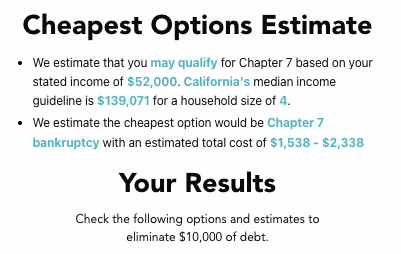
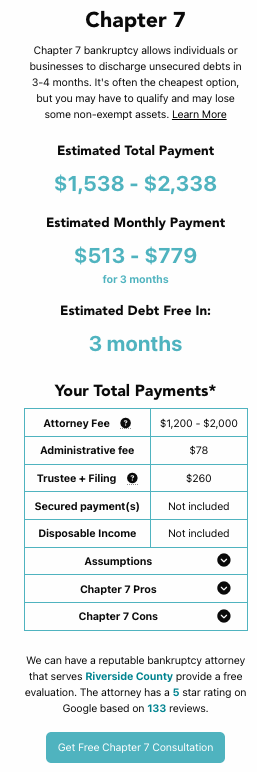
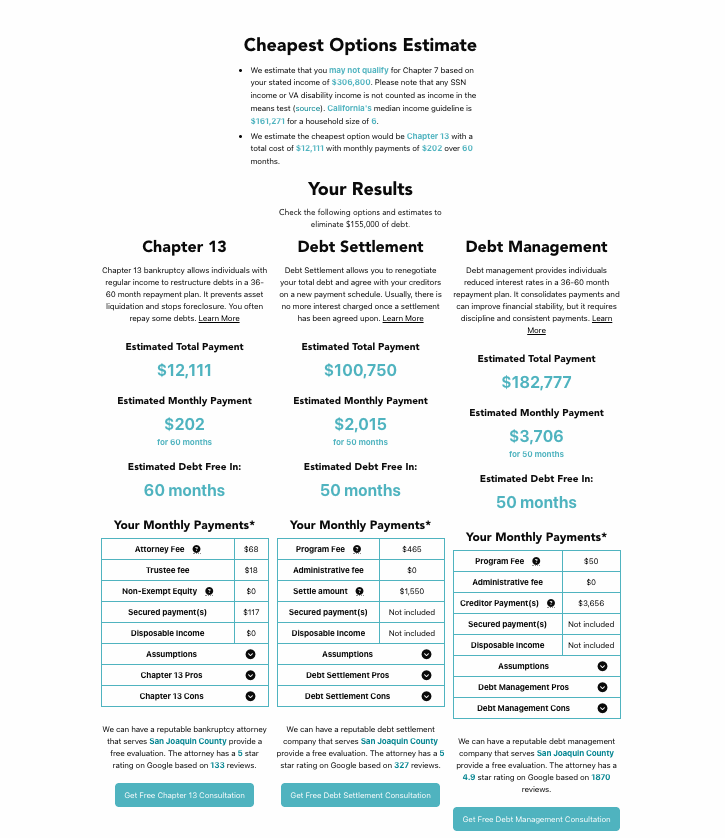
The bankruptcy means test may consider where you live in addition to both local and national standards when deciding disposable income. What this means is that you may not be able to use your real expenses that are higher than the allowed expenses to help reduce your disposable income.
There are some instances where you are able to use expenses such as car payments, childcare, mortgages, health insurance, and taxes to pass the Chapter 7 means test by deducting the actual expenses.
For example, let's say that you are a higher-earning debtor with income above the median based on your household size in your state. You may be able to pass the means test if you are able to reduce some of your actual expenses from your earnings for the means test. A qualified bankruptcy attorney should be able to walk you through this piece.
For expenses like car payments, childcare, mortgages, health insurance, taxes to mention but a few, you can pass the means test by deducting the actual expenses. For instance, let’s say that you are a high-earnings debtor. Do you know that you can still pass the means test if you also have a massive mortgage expense? This is because you can deduct the full mortgage amount from your earnings on the means test.
If you took the calculator above and it shows that you may not qualify, try taking the Chapter 7 Above Median Calculator to see whether you may still qualify for Chapter 7. The Above Median Calculator uses part 2 of the means test, specifically these bankruptcy forms: Statement of Exemption from Presumption of Abuse Under §707(b)(2) and the Chapter 7 Means Test Calculation.
Below is a picture of the actual means test form that our Chapter 7 means test calculator follows:

What if you pass the means test, but have property that you could lose if you file bankruptcy?
One of the most common questions is, "What happens to my home or vehicle if I own a significant amount of equity in that asset?"
In many cases, some home equity is protected under exemptions. In this instance, you can check the bankruptcy homestead exemptions for your state to determine whether your house is at risk in a Chapter 7 bankruptcy.
You can also find relevant information how to keep your house and how to keep your vehicle in bankruptcy using exemptions.
If you are above the exemptions or do not qualify for Chapter 7, you may look to restructure your debts and make the payments through a Chapter 13 Bankruptcy.
The bankruptcy means test has different requirements based on the state where you reside. You can see the information related to your state in one of the guides below.
There are a few main alternatives to Chapter 7 Bankruptcy. Each debt relief alternative has its own set of pros and cons. Here are the main alternatives to Chapter 7 bankruptcy:
As with every debt relief action, there is a severity associated with that action.
Not necessarily. For example, you could qualify for a Chapter 7 bankruptcy, but only have $100 in total debt. A Chapter 7 bankruptcy may be a drastic solution given such a low debt amount.
On the other hand, let’s say you have $300,000 in unsecured debt and recently lost your job, so you have no income. A Chapter 7 bankruptcy in this situation may make more sense, but it always depends on each situation and each individual.
We like to understand your goals for debt relief and your full financial picture before recommending that you speak with a bankruptcy attorney. Use the free Chapter 7 means test calculator below or you can use other free bankruptcy calculators online to estimate your cost and qualification.




 Yes
Yes No
No