How the Site Works: Ascend's mission is to take the pain out of personal finance for everyone. Not everyone who comes to our site is currently best fit for the Ascend product, so we spend a great deal of time and effort finding partners that we hope will be beneficial to you.
How We Make Money: Our partners sometimes compensate us in the way of advertising. Some partners we recommend pay us referral fees for sending them new customers. If you click through an application link on our site and end up receiving the service, we may receive compensation when your application is approved, and you move forward with this product. Each partner is vetted based on the following criteria:
Ascend generates around 5,000-6,000 bankruptcy leads per month nationwide, and we have built the infrastructure to share with you on how you can get free and paid bankruptcy leads through Search Engine Optimization (SEO) and the Google Maps 3-pack. Let's cover 9 different ways that you can get bankruptcy leads today, and then later I'll share the Ascend bankruptcy leads relationship management tool (LRM), which is a LawPay partner, that automatically follows up with your leads via text and emails (and calls), so that you don't have to hire a full-time staff to do so.
The best bankruptcy leads are those who:
We have purchased numerous leads in the past that may need to file, but have absolutely no funds available to file. You may also run into bankruptcy leads that are judgment-proof due to having only Social Security income. Now let's cover the different bankruptcy lead options.
You can get many bankruptcy attorney leads by getting on the Google Local 3-Pack for Google My Business. In short, the Google local business 3-pack is the first 3 businesses when doing a search for a specific business. Many consider this the holy grail of SEO, but it is quite challenging to obtain.
You may need to get many bankruptcy attorney reviews to get into the top 3 positions. You may consider bankruptcy software for attorneys' reviews.
In addition, we wrote an entire guide to help bankruptcy attorneys get free bankruptcy attorney leads from the Google 3-Pack.
Let's look at an example. See the Google local business 3-pack for "bankruptcy attorney San Francisco".
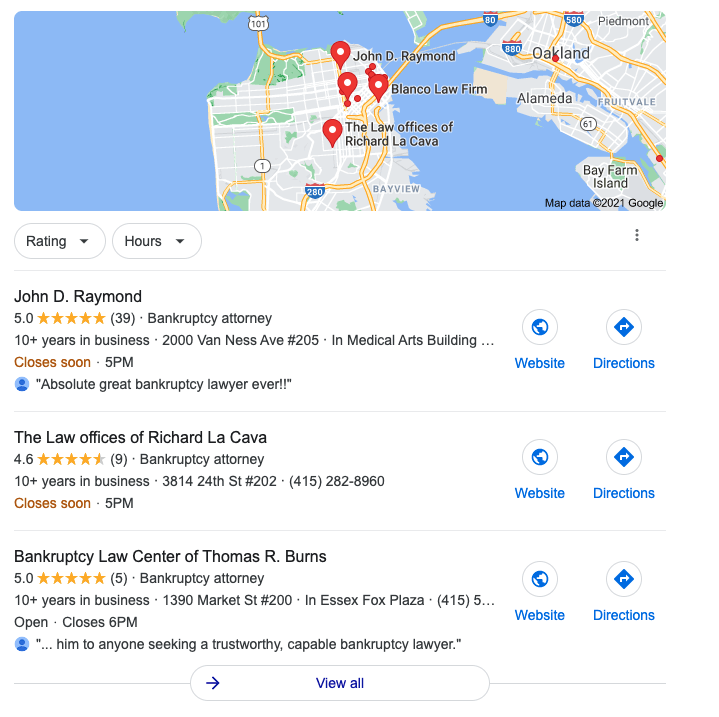
So, how do you rank in the Google Local Business 3-Pack to get bankruptcy attorney leads? Our hypothesis is that it's a combination of the following:
Ranking in the Google Local 3-Pack is not just about having a Google Business Profile. Google says local rankings are primarily based on relevance, distance, and prominence. In simple terms, Google wants to know whether your bankruptcy law firm is a strong match for the search, how close your office is to the searcher, and how reputable your firm appears online.
For bankruptcy attorneys, this means your Google Business Profile should clearly show that you handle bankruptcy cases. Your primary category, services, business description, photos, website, and reviews should all help Google understand that you are a bankruptcy attorney serving a specific city or region.
Some practical things that may help include:
The goal is to make it extremely clear to Google and potential clients that your firm helps people in your area resolve debt through bankruptcy.
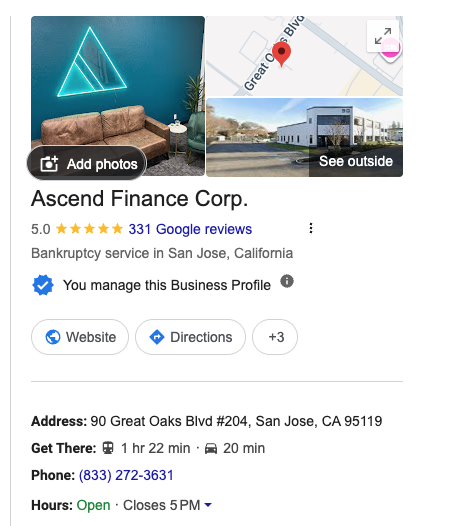
Reviews are one of the most important parts of Google Maps visibility because they help establish trust before a potential client ever contacts your law firm. Someone searching “bankruptcy attorney near me” may be overwhelmed, embarrassed, or dealing with lawsuits, garnishments, repossession, foreclosure, or credit card debt. They are often looking for reassurance that your firm is responsive, professional, and experienced. As you can see below, we have a perfect 5.0 rating on Google, based on over 331 reviews.
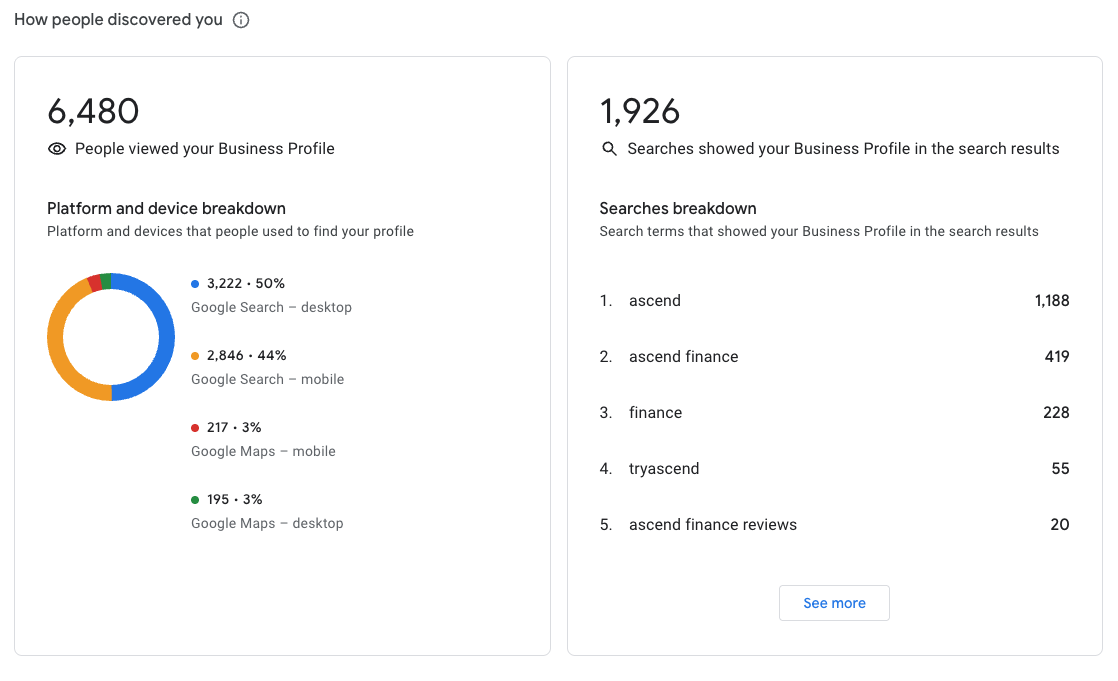
A bankruptcy attorney with many positive reviews may stand out more than a firm with few reviews, even if both firms appear in the same Google search results. Review volume, review quality, and review recency can all influence how a potential client evaluates your firm. Google also identifies prominence as a local ranking factor, and prominence can include review count and review score.
You should also respond to reviews when appropriate. A simple, professional response can show that your firm is active and attentive. For legal and ethical reasons, avoid revealing confidential client information in review responses. Instead of saying something specific like “We’re glad we helped stop your garnishment,” you may say something more general, such as, “Thank you for your kind words. We appreciate the opportunity to help.”
Getting into the Google 3-Pack is only part of the goal. The next step is converting that visibility into actual bankruptcy attorney leads. When someone clicks on your Google Business Profile, they should immediately see clear ways to contact your firm.
Make sure your profile has the correct phone number, website link, business hours, appointment link if available, and a strong description of the bankruptcy services you offer. If someone is searching during a financial emergency, they may choose the attorney who makes it easiest to take the next step.
Your website should also match the search intent. If someone clicks from your Google profile to your website, they should land on a page that explains bankruptcy options clearly, answers common questions, and offers a direct call-to-action. For example, you may include buttons such as “Schedule a Free Bankruptcy Consultation,” “Check Chapter 7 Eligibility,” or “Speak With a Bankruptcy Attorney.”
You may also want dedicated pages for high-intent searches such as:
The more aligned your Google profile, website, reviews, and local content are, the better chance you have of turning Google Maps visibility into real bankruptcy consultations.
Search Engine Optimization (SEO) is the skill of optimizing your website to be helpful to readers. The goal of SEO is to provide helpful, contextual content to the reader. In return, Google will award you with a higher ranking. Google may use factors such as page load speed, time on page, and user interaction with your page to help determine whether to give you a coveted top-5 search spot. Another important thing that Google uses to determine how to rank websites is whether that website got links referencing to the site from other sources.
Now, you must realize that Google separates paid ads from SEO. With paid ads, you can move up the rankings, potentially with lower-quality content (even though quality still matters).
Let's illustrate that point. See the image below for the search term, "Chapter 13 calculator". This search returned 3 ads and 1 organic result. You will notice that the ads will always have "Ad" next to the title.

One of the best ways bankruptcy attorneys can improve SEO is by creating pages that match what people are actually searching for. A general “bankruptcy attorney” page can be helpful, but many potential clients search with a more specific problem in mind.
For example, someone may search:
Each of these searches has a different intent. Some people are looking for legal education. Others are close to hiring an attorney. A strong bankruptcy SEO strategy should include both types of content.
For example, an attorney may want pages for:
The goal is to create helpful pages that answer the person’s question clearly while also showing why speaking with a bankruptcy attorney may be the next best step.
Bankruptcy is federal law, but most people search locally when they are looking for help. That means a bankruptcy attorney’s website should make it clear which cities, counties, and regions the firm serves.
For example, instead of only having a general “Bankruptcy Attorney” page, a firm may create a page titled “Bankruptcy Attorney in [City]” or “Chapter 13 Bankruptcy Lawyer in [City].” This page should not just swap out the city name and repeat the same content. It should include genuinely helpful local context.
A local bankruptcy SEO page may include:
This can help Google understand where the law firm provides services. It can also help potential clients feel like the attorney understands their local area, not just bankruptcy in general.
For example, a page for “Bankruptcy Attorney in San Francisco” may discuss the high cost of living, credit card debt, personal loans, wage garnishments, lawsuits, and Chapter 13 considerations for people trying to protect assets or catch up on secured debts.
SEO is not only about keywords. It is also about trust. This is especially important for bankruptcy attorneys because people are often making a serious financial and legal decision. A potential client may be deciding whether to share sensitive debt, income, asset, and lawsuit information with your firm.
A bankruptcy attorney website should make trust easy to identify. Helpful trust signals may include:
These trust signals can help with conversions and may also support SEO indirectly. If visitors stay on the page longer, click to other pages, call your office, or submit a consultation form, those behaviors may suggest that the page is useful.
For bankruptcy attorneys, the best SEO content does not just bring traffic. It should help the reader understand their options, reduce confusion, and encourage the right potential clients to request a consultation.
You may not get many bankruptcy leads from word-of-mouth referrals because many people don't talk to friends and family about debt issues. That said, you may receive bankruptcy leads from other attorneys who do not practice bankruptcy law.
For example, a family attorney helping a couple through a divorce may need a bankruptcy attorney to refer people to. You could set up a relationship where you would send family-related legal matters in exchange for bankruptcy leads.
There are a variety of ways that you can do this, and some may also opt for some sort of paid arrangement in accordance with 11 U.S. Code § 504 - Sharing of compensation.
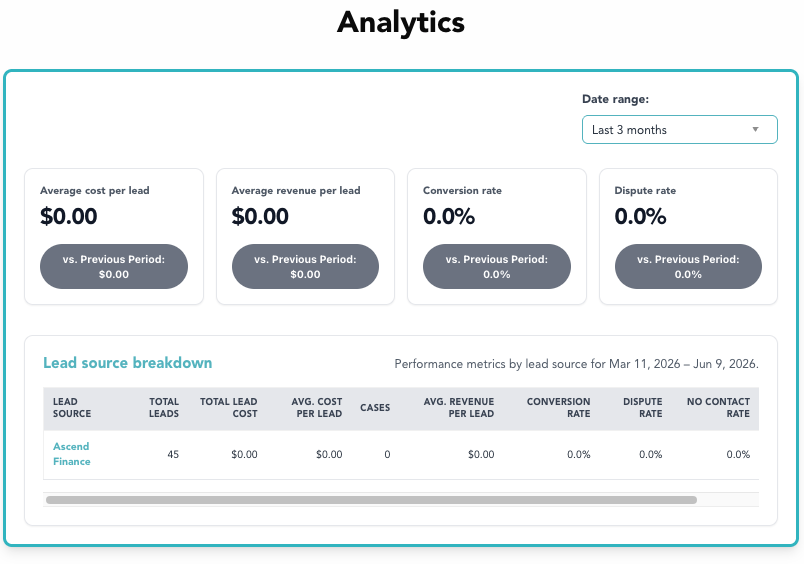
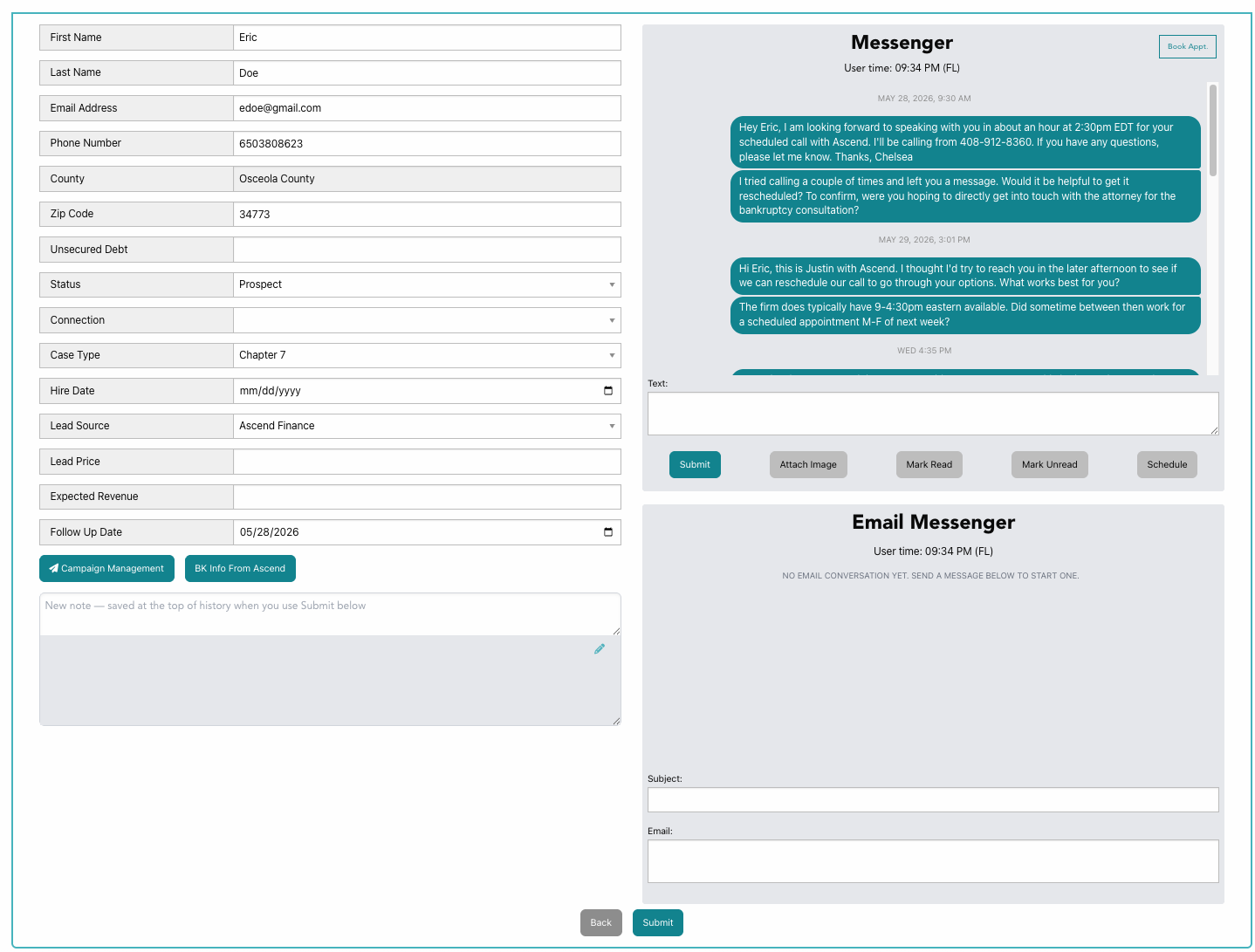
A recent bankruptcy attorney in Tennessee asked us, "Why don't you white-label your bankruptcy calculators and allow me to embed the calculator on my website?"
Many bankruptcy attorneys have visitors to their page, but those visitors don't actually turn into webform submissions (i.e. bankruptcy leads). As such, we realized that our bankruptcy calculators can be highly beneficial in turning these low-performing pages into high-performing bankruptcy lead pages.
So, we have already built the bankruptcy calculators, but this is what we are considering for those of you who would want to embed the bankruptcy calculator on your website:
No upfront costs
No monthly retainer
No need for engineering resources
Ascend would do the work to add the calculator to the appropriate pages
10 free bankruptcy leads. After that, it would be just $9.99 per lead.
The main requirement we would have is that your website has some visitor traffic.
Many attorneys and bankruptcy lead services use Google (and sometimes Bing) to get bankruptcy attorney leads. The reason is partial that you can get search intent. For example, someone searching for "file bankruptcy now" or "bankruptcy attorney near me" may have a high intent to file bankruptcy. We have had more success with Google than Bing over the years, but we still run Bing ads.
Unfortunately, Google ads are difficult to navigate for a couple of reasons:
The Google Ads system is very complex. I worked at Google from 2012 to 2015, so I have many years of experience with the system. That said, I cannot imagine working in Google ads for the first time.
Secondly, when you sign up for Google ads, you are placed on a simpler version. It's probably to make sure you succeed (and don't become too overwhelmed), but I have found that it's so simple that it actually is hard to succeed. Take a look at this test I ran below on the simpler version
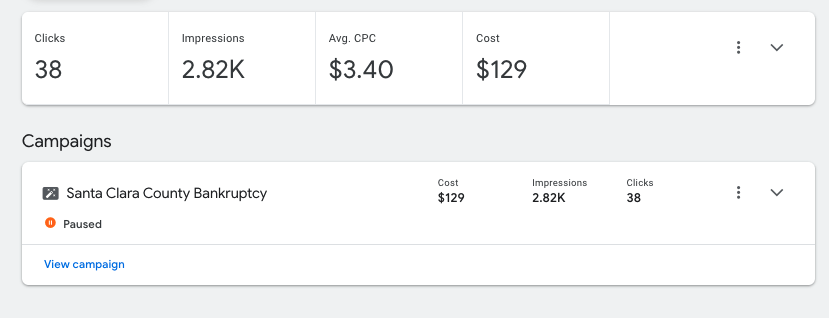
How does $50 PER CLICK sound? That's not per bankruptcy lead or per client. That is per click.
Google prices the terms based on an auction system, so you are competing against other bankruptcy attorneys or lead services or debt settlement companies. Thus, your cost per click for "file bankruptcy now" could be very high, making those terms cost-prohibitive.
The amount you spend to acquire a customer is called your "cost of acquiring a customer" (CAC). In my opinion, your CAC should always be below 50%, so if you charge $1,500 in fees for a Chapter 7, you should not spend more than $750 to acquire the customer. That said, I believe a good target is 33-35%, though.
We have not seen the success getting bankruptcy attorney leads in Facebook / Instagram ads that we have seen in Google and Bing Ads. Why? I believe it's mainly based on users' intent.
With Facebook, you have a better opportunity to segment your audience, but it's difficult to know who is searching for bankruptcy and who is not.
With Google and Bing, you have the intent of the user's search, which is in relation to bankruptcy. Unfortunately, you are not able to specify your audience like Facebook.
That said, I believe it is possible with the right tools to get bankruptcy leads through Facebook. It's something we will continue to test in the coming months and years.
Bankruptcy lead services are another avenue that people use to get access to bankruptcy leads. These firms specialize in marketing to obtain folks who are interested in bankruptcy. There are numerous firms that provide bankruptcy leads, so if you go this route, you may want to run tests to see how these leads perform for you. The bigger bankruptcy lead services may be 4Legalleads, NOLO, or Lawyer Marketing.
We are Ascend are a growing player in the bankruptcy lead space, and have grown from 2 bankruptcy attorney partners to 125+ partners in 2023. Unfortunately, we have very little availability in the US as we do send exclusive leads, but please learn more about our offering here and reach out,
There are 4 things to look out for when using a bankruptcy lead service:
You may think that this is a given, but some bankruptcy lead services sell the same lead to multiple firms. The cost per lead is generally lower, but that means that you are in competition from the start to get a hold of the individual quickly. This should also reduce your conversion rate. I am not sure how the potential client feels getting calls, texts, and emails from multiple bankruptcy firms.
Understanding pricing is important. How many tiers of pricing do they have? I have always been somewhat suspicious of the firms that only do price per lead. Generally, if you have great leads, you want to do price per qualified lead (only get paid when an individual becomes a client. If you have poor to great leads, you may want the price per lead because the conversion rate may be low This is not always the case, but I appreciate when bankruptcy lead services provided different tiers of pricing.
In all bankruptcy lead services, you will have wrong numbers and bad numbers. Ascend runs an API verification of phone and email, but there are still bad ones sometimes. Often you will have to pay for leads you don't get a hold of. That said, you should confirm that you can dispute bad leads.
You may think that the bankruptcy lead service gets leads through a bankruptcy site sharing information about bankruptcy. That's not always the case. I have heard horror stories from bankruptcy attorneys who said they got "bankruptcy leads" from people that had no interest in filing bankruptcy.
You will see personal injury attorneys advertise on billboards/buses/signs for personal injury leads, but I have not seen it as often for bankruptcy attorney leads.
One bankruptcy attorney partner mentioned that he saw them in Orlando, but personal injury leads may produce more revenue. Also, personal injury attorneys are targeting people who have gotten in a car accident, so it's likely that those individuals may still be driving on the streets.
You may have gotten an email about becoming a sponsored source on a legal search website. These can includes Avvo specifically for legal services and potentially something like Thumbtack that is broader, but provides bankruptcy attorneys as an option.
These sites may charge you a monthly retainer or a pay-per-lead basis. The key for these sites if you pay a monthly retainer is how much foot traffic will these pages get in a month. For example, I spoke with one attorney recently that paid around $700-$800 per month to be a sponsored attorney, and he didn't know exactly how many leads he got from that site.
For example, this means he could have paid almost $10,000 per year in fees, and may have not ever gotten any leads from the site if there's no one visiting the page. Here's an example below (source) for Memphis, Tennessee.

Also, many attorneys have been burned by bankruptcy lead providers, which is why we offer 100% no risk trials where the 10-lead test is free if you do not get a certain threshold in attorney fees.
We have grown from 2 attorney partners in 2019 to over 120 partners in 2026 with very low attrition.
If you are interested, please reach out to us directly via this form.


 Yes
Yes No
No