How the Site Works: Ascend's mission is to take the pain out of personal finance for everyone. Not everyone who comes to our site is currently best fit for the Ascend product, so we spend a great deal of time and effort finding partners that we hope will be beneficial to you.
How We Make Money: Our partners sometimes compensate us in the way of advertising. Some partners we recommend pay us referral fees for sending them new customers. If you click through an application link on our site and end up receiving the service, we may receive compensation when your application is approved, and you move forward with this product. Each partner is vetted based on the following criteria:
Have you received calls from National Debt Relief at 347-394-2675 and wonder how much in fees you are going to pay in the program?
As a former CEO of a debt relief company, I have extensive knowledge about debt settlement fees. I believe fees are one of the most important factors to consider when selecting a debt settlement company.
The purpose of this article is to provide a highly granular breakdown of the fees you will incur.
Here’s what we will cover:
National Debt Relief charges the average client between 15-25% of the enrolled debt. That is a huge variance, and the difference can be thousands of dollars in fees, ranging from 15 to 25%. Freedom Debt Relief is another large debt relief firm that states its fees average 21.5%, so I hypothesize that National Debt Relief would charge closer to 25% than 15%.
The fees charged are critical, so doing your research is essential. Consider the following example to see how much you may pay in fees with a 15% vs. 25% rate.

You can see that the individual paying 25% is paying $5,000 more for potentially the same type of program. That’s a huge amount.
Please note that the above example is based on someone who is tax insolvent. It’s also important to understand how tax consequences work in debt settlement.
Unfortunately, most debt relief companies are not forthcoming about the fees. The best way to find what your National Debt Relief fees would be is by:
The Debt Negotiation Agreement is a 20-page document that outlines the fees, the services National Debt Relief will provide, and other pertinent information about the program.
On or around page 3 of the Debt Negotiation Agreement, under the “Fees” section, you should see the % amount for your program. It may also include the estimated number of months and the annualized percentage basis. I do not consider the annualized percentage basis as this is not a loan. If you have not received a debt negotiation agreement yet, you may be able to find that exact amount from the National Debt Relief sales representative.
When we were a debt relief company, we would communicate the fee on the phone and also have it in an easy-to-find place on the client services agreement. See an example below:
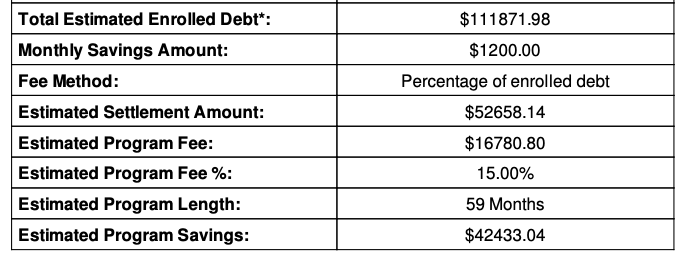
One key area Ascend has focused on is debt settlement fee transparency. As such, we built the following debt settlement fee calculator to allow you to compare fees and make the most informed decision.
The free resource below can help you estimate your monthly payment, compare fees, and estimate how much you may save.
We have also helped many individuals consolidate their settlement programs into a program that charges much less in fees.
There are 2 other fees you will want to be cognizant of that may be associated with your National Debt Relief program, but are not charged by National Debt Relief.
Firstly, you will most likely have to pay a monthly bank account escrow fee. This fee would be charged before the first settlement and would go to the payment processor handling the money movements, including your draft and settlements.
When you sign up for the program, you will set up a special-purpose escrow bank account. This bank account will house all of your monthly drafts. When National Debt Relief settles an account, the payments would be taken from this account. National Debt Relief’s fees will also be drawn from this account.
You own the escrow bank account, and National Debt Relief will present settlement offers to you, which you can accept or reject. Once received, this is when National Debt Relief can pull the fees and payments from this account.
Because debt settlement companies can prevent debt collection lawsuits, many debt settlement companies pitch a legal plan. This can cost quite a bit of money. My view is that the debt settlement company you work with should know which debt collectors sue and prioritize those debts first to avoid this cost altogether.
For example, if your creditor’ has a low lawsuit likelihood, then what is the purpose of the additional fee of potentially around $3,000 - $4,000 over the life of the program.
Many debt settlement companies, including National Debt Relief, pitch that you do not have to pay the fees until after you have settled an account.
Please note this is not specific to National Debt Relief. Because debt settlement companies were charging fees before settlements, the FTC amended the Telemarketing Sales Rule in 2010 to include that debt relief companies cannot charge fees before the first settlement.
Let’s look at the following example of when fees may be charged. The example below estimates settlement at month 6, but that may vary.

You may notice on your National Debt Relief dashboard that a payment of $325 was made to the creditor, but the full $ 2,100 fee was deducted immediately.
In the above example, the first payment was made on April 7, 2022, and the fee was deducted on April 8, 2022, for the full amount. Actual results may vary. You will also notice that the 21% fee in this example is based on the enrolled debt amount, not the balance owed at settlement.
Finally, the fee is deducted after each settled debt, not from all accounts at once.
National Debt Relief quotes a fee range between 15% and 25% of your enrolled debt. That is a significant variance, with a 25% fee potentially costing you thousands or tens of thousands of dollars more over the life of the program. You can also consider the pros and cons of National Debt Relief's program when making the decision.
Hopefully, you now understand how National Debt Relief fees work, when they charge you those fees, and alternative debt relief program fees to help you make the most informed decision.

 Yes
Yes No
No