

First Advantage Debt Relief Reviews: 3 Things to Know
A First Advantage advertisement claimed that more than $30,000 was deposited into a consumer’s checking account even though it was not a personal loan, was not bankruptcy and supposedly did not have to be paid back.
Those statements naturally raise questions. If the money was not a loan and did not need to be repaid, what was the actual product—and what happened to the underlying debt?
I clicked through the advertisement, reviewed the application flow and examined the companies listed as potential partners. Here are the three most important findings.
1. What Did the First Advantage Advertisement Claim?
The advertisement I reviewed featured Meylin Lopez discussing financial difficulty and her faith. Because the ad opened with religious language, it appeared designed to resonate with Christian viewers.
I had seen a similar presentation involving Christian Savings Club , so I paid particular attention to what financial product was actually being described.

The ad later showed bills and cash while making three notable statements:


The three claims create an incomplete picture without further explanation
A company generally does not provide $30,000 in unrestricted cash without either creating a repayment obligation, paying existing debts or requiring the consumer to fund some other arrangement.
Consumers should ask whether the number shown represents loan proceeds, existing debt enrolled in a program, projected debt reduction or settlement funds rather than money the consumer can freely keep.
What Could “You Do Not Have to Pay It Back” Mean?
In debt-settlement marketing, a large number may represent the amount of enrolled debt or the portion a company expects creditors might forgive. That is very different from receiving that same amount as cash.
| Possible Meaning | What Actually Happens | What the Consumer Still Pays |
|---|---|---|
| Personal loan | A lender deposits money or pays creditors on the borrower’s behalf. | The borrower repays principal, interest and applicable fees. |
| Debt-settlement enrollment | Existing unsecured debts are enrolled and negotiations may occur after money accumulates. | The consumer funds creditor settlements, program fees and possible account costs. |
| Projected debt forgiveness | A creditor may agree to accept less than the full balance. | The consumer still pays the agreed settlement, fees and possible taxes. |
| Chapter 7 bankruptcy | Qualifying debts may be discharged through a federal court process. | Court costs, required courses and possible attorney fees apply. |
2. What Does First Advantage Currently Do?
This means First Advantage may collect preliminary information about your debts and circumstances, then refer you to another company that offers a loan, debt-settlement program, debt-management plan or other financial service.
First Advantage’s website also displays claims involving requested consultations and enrolled debt. Those figures should be read alongside the disclaimer that First Advantage itself does not provide the underlying debt-settlement or lending service.
Review the current First Advantage website and disclosures before relying on an older advertisement or screenshot.
Why the distinction matters
- The company in the advertisement may not provide the service.
- A separate provider determines the fees and eligibility rules.
- Your information may be sent to one or more third parties.
- The final agreement may use a different legal business name.
- Reviews of First Advantage may not describe the actual provider.
- Cancellation rights depend on the agreement you ultimately sign.
Which Companies May Receive a First Advantage Referral?
When I completed the application flow, the final page displayed several potential partners. The captured list included companies such as TurboDebt and JG Wentworth .
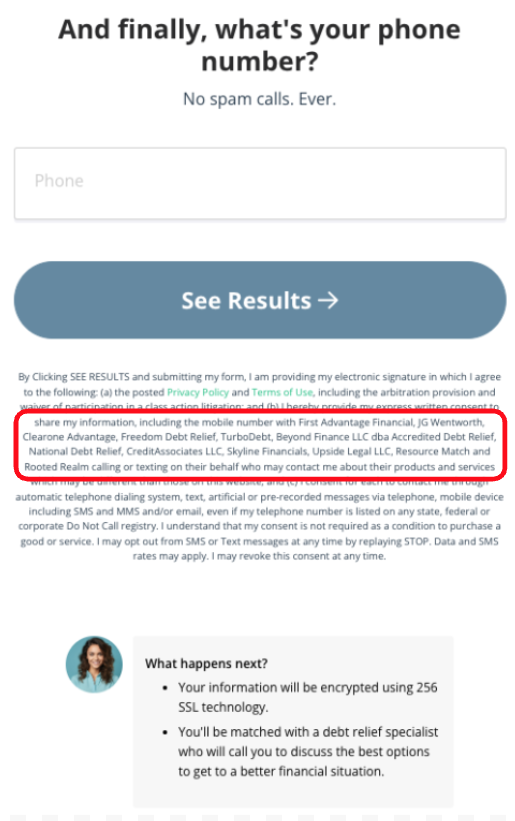
A partner list does not tell you which company will contact you
Before submitting the form, read the consent language to determine which businesses may receive your information, whether multiple companies may contact you and whether calls or texts may use automated technology.
The provider that contacts you should clearly disclose:
- Its legal business name
- The service being offered
- Whether it is a lender or settlement company
- The exact fee structure
- The debts that qualify
- Whether you must stop paying creditors
- The expected timeline
- Cancellation and refund provisions
Compare the Six Main Debt Options
Before responding to a debt-relief advertisement, compare the proposed payment with consolidation, nonprofit credit counseling, debt settlement, direct payoff, Chapter 7 bankruptcy and Chapter 13 bankruptcy.
Debt Options and Monthly Payment Calculator
Enter your debt, income and household information to compare estimated payments, costs, durations and tradeoffs.
Results are educational estimates and are not an offer from First Advantage or any partner company.
What Is Debt Settlement?
Debt settlement is a negotiated debt-reduction strategy. A consumer generally stops making normal payments on enrolled unsecured accounts and instead saves money for potential settlements.
- Eligible debts are enrolled.
Programs generally focus on unsecured debts such as credit cards, personal loans and certain medical bills. - The consumer builds settlement funds.
Money is typically deposited into a dedicated account owned by the consumer. - Accounts become delinquent.
Interest, late fees, collection calls and credit damage may occur while funds accumulate. - The provider attempts negotiations.
Creditors may accept, reject or counter a proposed settlement. - The consumer approves each offer.
A creditor payment and applicable earned fee are made after approval.
Read the Consumer Financial Protection Bureau’s explanation of the differences among credit counseling, debt settlement and debt consolidation .
Debt settlement is not the same as debt consolidation
A conventional consolidation loan pays or replaces existing debts with a new loan. Debt settlement generally involves delinquency and negotiations for less than the contractual balance. Marketing sometimes uses “consolidation” broadly even when no new loan is provided.
Potential Debt-Settlement Advantages and Risks
| Potential Advantage | Explanation | Importance |
|---|---|---|
| Reduced balances | A creditor may accept less than the full contractual balance. Results vary, and no settlement percentage is guaranteed. | High |
| Potentially lower monthly deposit | The proposed savings deposit may be lower than current minimum payments, although lower deposits can lengthen the program. | High |
| Avoiding bankruptcy | Settlement may be considered by consumers who prefer not to file a bankruptcy case. | Medium |
| Flexible negotiation | Offers can be evaluated creditor by creditor rather than through one court-ordered repayment formula. | Medium |
| Potentially faster than minimum payments | A completed settlement program may resolve debt faster than decades of minimum payments at high interest. | Medium |
| Potential Risk | Explanation | Importance |
|---|---|---|
| Credit damage | Programs commonly involve missed payments, charge-offs and settlements reported for less than the full balance. | High |
| Creditor lawsuits | Enrollment does not create an automatic stay. A creditor may sue while settlement funds are accumulating. | High |
| Interest and late fees | Balances may continue increasing before an account is settled. | High |
| No required participation | A creditor is not legally required to accept a voluntary settlement. | High |
| Program fees | The provider may charge a substantial percentage of enrolled debt or savings, subject to the agreement and applicable law. | High |
| Possible taxes | Forgiven debt can be taxable unless bankruptcy, insolvency or another exclusion applies. | Medium |
| Higher cost than Chapter 7 | For qualifying consumers, settlement payments and fees may materially exceed the total cost of Chapter 7 bankruptcy. | Medium |
Review the Federal Trade Commission’s debt-relief services and advance-fee guidance and IRS Topic 431 on canceled debt .
How Debt Settlement Compares With Other Options
| Option | Primary Benefit | Primary Limitation |
|---|---|---|
| Debt-consolidation loan | Can replace several debts with one loan and may reduce interest for qualified borrowers. | Approval and pricing depend on credit, income and underwriting. |
| Debt-management plan | May lower participating credit-card interest without deliberately settling principal. | Principal is generally repaid in full and enrolled cards may close. |
| Debt settlement | May resolve qualifying debts for less than the full balance. | Usually involves delinquency, fees, collection risk and no guaranteed outcome. |
| Chapter 7 bankruptcy | May discharge qualifying unsecured debts relatively quickly. | Eligibility, exemptions and nondischargeable debts must be reviewed. |
| Chapter 13 bankruptcy | Provides a court-supervised plan and may protect property or cure arrears. | Usually requires three to five years of plan payments. |
| Direct hardship request | A creditor may reduce interest or provide temporary payment relief without a third-party program. | Relief varies by creditor and may not solve a broader debt problem. |
Additional Ascend resources include:
3. What Do First Advantage Debt Relief Reviews Say?
The original review search did not identify a meaningful BBB, Trustpilot or Consumer Reports profile specifically for the First Advantage debt-relief referral website.

Has Consumer Reports reviewed First Advantage Debt Relief?
I searched Consumer Reports and did not locate a review clearly covering this particular First Advantage debt-relief referral service.
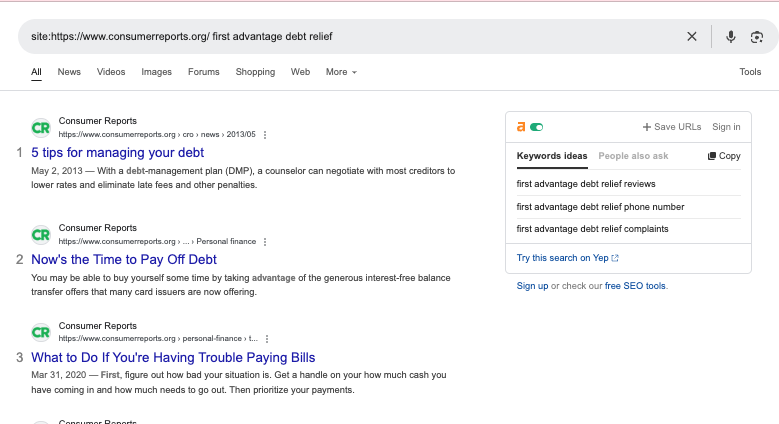
Do not rely on reviews for the wrong “First Advantage” company
Before relying on a review, compare the domain, address, phone number, service description and legal business name. Reviews of a background screening company or debt collector do not necessarily describe the First Advantage referral website discussed here.
Finder’s separate review likewise reported that it could not locate relevant BBB or Trustpilot reviews for this particular service and characterized First Advantage as a referral service rather than the company actually negotiating debts.
You can read the Finder First Advantage review as an additional third-party perspective.
Questions to Ask Before Submitting Your Information
- What service am I applying for?
Ask whether the potential result is a loan, debt-management plan, settlement program or another product. - Is First Advantage the provider?
Ask for the legal name of the company that will provide the service and appear on the agreement. - Who will receive my information?
Review the partner list, privacy policy and telephone-consent disclosures. - Will my credit be checked?
Determine whether a soft or hard inquiry may occur and which company will request it. - What fees will apply?
Request the fee percentage, calculation method and estimated dollar amount. - Must I stop paying creditors?
If so, ask how the program addresses credit damage, collection calls and lawsuits. - Is any savings estimate guaranteed?
Creditors are generally not required to accept voluntary settlement offers. - What happens if I cancel?
Review dedicated-account access, earned fees, pending settlements and refund timing.
Documents to review before enrolling
- Privacy policy
- Telephone and text consent
- Provider disclosure
- Debt-relief agreement
- Fee schedule
- Dedicated-account agreement
- Cancellation provision
- Creditor-risk disclosure
- Estimated program timeline
- Tax disclosure
Frequently Asked Questions
Is First Advantage Debt Relief a lender?
No. First Advantage’s current website states that it is not a lender. It connects consumers with third-party debt-relief providers.
Is First Advantage a debt-settlement company?
Its current website says it is not a debt-settlement company. A third-party provider may offer settlement after receiving the consumer’s information.
Does First Advantage give consumers $30,000 in free cash?
The advertisement contained language about more than $30,000, but consumers should not assume this means unrestricted cash with no obligation. Ask whether the number represents enrolled debt, potential forgiveness, settlement funds or another calculation.
What does “you do not have to pay it back” mean?
It may refer to a portion of debt a creditor agrees to forgive—not money deposited for the consumer to keep. The consumer generally still pays settlements, provider fees and possible account costs.
Does debt settlement provide a new consolidation loan?
No. Debt settlement normally involves saving money and negotiating reduced balances. A consolidation loan is new credit used to repay or replace existing debts.
Will First Advantage share my information?
First Advantage describes itself as connecting consumers with third-party providers. Read the privacy and consent language to determine which companies may receive your information and contact you.
Which companies may contact me?
The captured partner disclosure included companies such as TurboDebt and JG Wentworth, but partner lists and routing can change. Review the current disclosure before submitting the form.
Are there First Advantage Debt Relief reviews on Trustpilot?
No relevant Trustpilot profile for this specific debt-relief referral service was identified during the review. Be careful not to confuse it with unrelated companies using the First Advantage name.
Has Consumer Reports reviewed First Advantage?
The original research did not identify Consumer Reports coverage clearly addressing this specific First Advantage debt-relief referral website.
Can creditors sue during debt settlement?
Yes. Debt-settlement enrollment does not create an automatic stay. Creditors may continue collection activity or file lawsuits while negotiations are pending.
Can forgiven debt be taxable?
Yes. Forgiven debt may be taxable unless an exclusion such as bankruptcy or insolvency applies.
What should I compare before enrolling?
Compare the monthly payment, total fees, expected settlements, timeline, credit effects, lawsuit risk, tax consequences and alternatives such as nonprofit credit counseling and bankruptcy.
Compare the Offer Before Sharing Your Information
First Advantage may help connect consumers with debt-relief providers, but it does not itself provide every service described by the companies in its network.
Before moving forward, compare the proposed program with a consolidation loan, nonprofit debt management, direct creditor hardship assistance, Chapter 7 and Chapter 13.
Advertisements, partner relationships, review availability, qualification criteria, fees and company disclosures may change. This article reports captured advertising and application content and does not verify that every advertised consumer result is typical. Confirm all material terms directly with the company that will provide the service.
 Yes
Yes No
No